On this page
- Price at a glance
- The $490 rule
- The list-size catch on beehiiv
- What you get besides the price
- Three real newsletters, priced on both
- Hidden costs on each side
- A real decision, start to finish
- What each one does better
- How to pay less on each
- Other tools worth a look
- Which one should you pick?
- Switching from Substack to beehiiv
- Questions to ask before you choose
- The cost over three years
- Who should use neither
- How we compared
- Our verdict
- beehiiv vs Substack FAQs
Some links on this page may earn us a commission. It never changes the numbers or the verdict. How we make money.
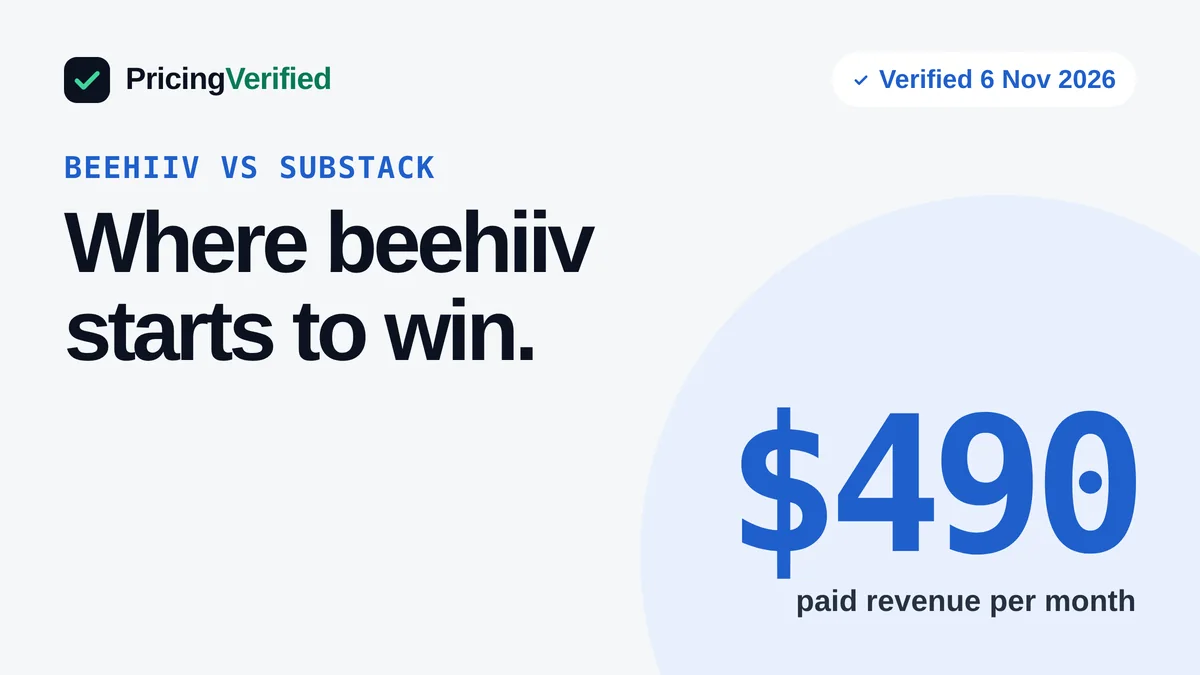
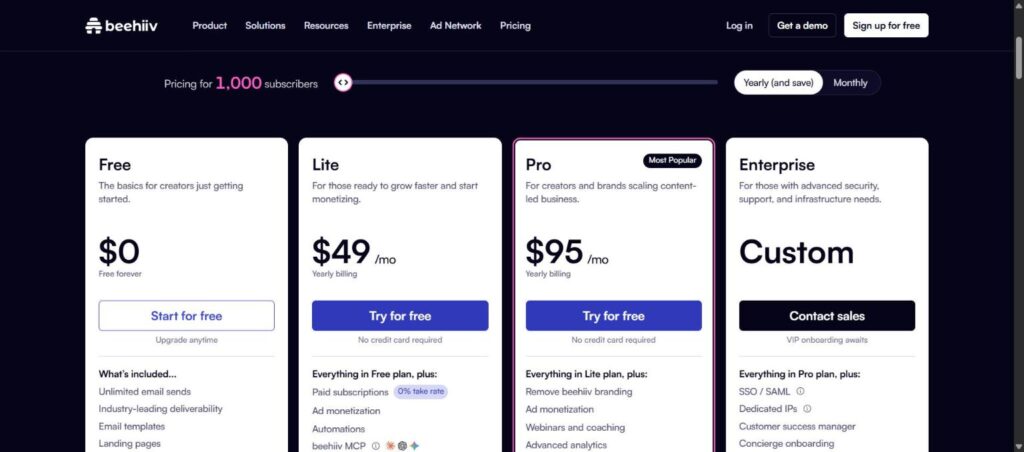
beehiiv vs Substack is really a question about money in, not money out. Substack costs $0 to use but keeps 10% of every paid subscription. beehiiv Lite costs $49 a month billed yearly at 1,000 subscribers and takes 0%. So the cheaper platform flips at one clear point: $490 a month in paid subscriptions.
I checked beehiiv’s pricing page on 3 and 6 November 2026, and Substack’s fee in its help center (updated 29 September 2026). Below is what each costs at your revenue, what you get, and when switching makes sense.
Earning less than about $490 a month from paid subscriptions? Substack’s 10% costs you less than beehiiv Lite. Earning more? beehiiv is cheaper, and the gap grows with every dollar. Not charging at all? Both are free to start.
Price at a glance
| Substack | beehiiv Free | beehiiv Lite | beehiiv Pro | |
|---|---|---|---|---|
| Plan price | $0 | $0 | $49/mo yearly · $59 monthly | $95/mo yearly · $109 monthly |
| Cut of paid subscriptions | 10% | Paid subs not available | 0% | 0% |
| Subscriber limit | None stated | Up to 2,500 | Priced by list size | Priced by list size |
| Ad network | — | No | Yes | Yes |
| Remove platform branding | — | No | No | Yes |
| Card processing | Stripe fees apply | — | Stripe fees apply | Stripe fees apply |
Sources: beehiiv.com/pricing (3 and 6 Nov 2026, prices at 1,000 subscribers) and Substack’s help center (updated 29 Sep 2026). beehiiv’s paid prices rise with list size.
The $490 rule
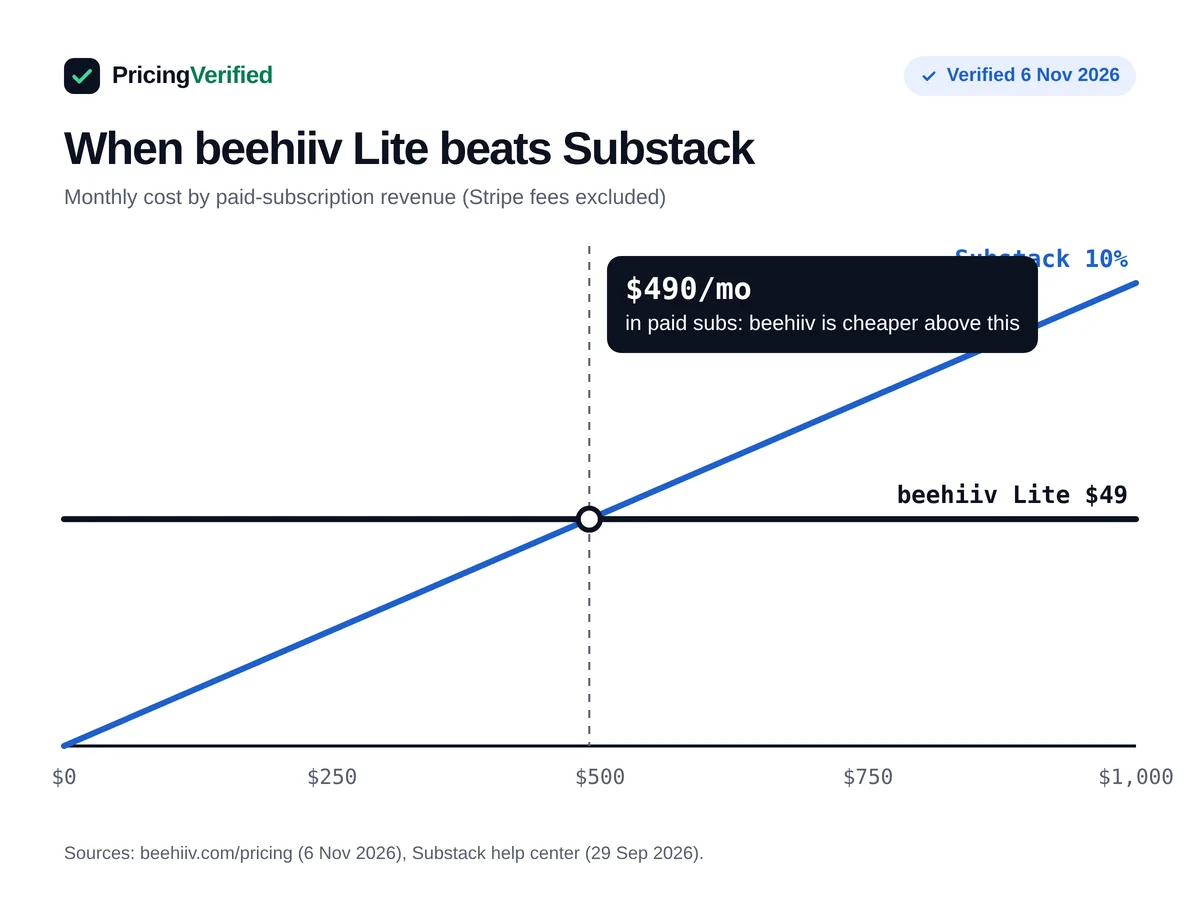
beehiiv Lite costs $49 a month billed yearly. Substack takes 10%. The two are equal when 10% of your paid revenue is $49. That happens at $490 a month.
| Paid subscription revenue | Substack’s 10% | beehiiv Lite (yearly) | Cheaper | Difference per year |
|---|---|---|---|---|
| $200/mo | $20 | $49 | Substack | $348 |
| $490/mo | $49 | $49 | Even | $0 |
| $1,000/mo | $100 | $49 | beehiiv | $612 |
| $5,000/mo | $500 | $49+ | beehiiv | up to about $5,400 |
Our arithmetic. Stripe’s card fees apply on both and are left out. On monthly billing ($59), the line moves to $590 a month. At bigger list sizes beehiiv costs more than $49, which narrows the gap.
The same rule in subscribers
Thinking in readers is easier. Here is how many paying subscribers it takes to reach $490 a month:
| Your monthly price | Paying subscribers for $490 |
|---|---|
| $5 | 98 |
| $8 | 62 |
| $10 | 49 |
| $15 | 33 |
Rounded up. Yearly subscriptions count as one-twelfth per month.
The list-size catch on beehiiv
Here is the honest part. beehiiv prices its paid plans by total subscribers, free and paid. The $49 we verified is at 1,000 subscribers. A newsletter with 100 paying readers often has a few thousand free readers too, so its Lite price will be higher.
The gap is still large for most paid newsletters. At $2,000 a month in paid subscriptions, Substack takes $200 a month. Even if your beehiiv Lite price were double the $49 we saw, beehiiv would still save you over $1,200 a year. Before you move, enter your real list size in beehiiv’s slider and compare with 10% of your revenue.
What you get besides the price
Growth tools
beehiiv is built around growing a newsletter: a referral program, growth tools and an ad network on Lite and above. Its pricing page also lists a website, podcast, community and digital products on all plans.
Audience and discovery
Substack’s main strength is its own reader network and app, which can bring new readers to you. That is a real benefit that does not show up on a price table. Weigh it against the 10% cut.
Money from sponsors
beehiiv Lite and Pro include its ad network, so sponsors can pay to appear in your issues. On Substack, you would arrange sponsors yourself.
Branding
beehiiv Pro removes beehiiv branding. Lite and Free show it.
Three real newsletters, priced on both
1. A free newsletter with 1,500 readers
No paid subscriptions. Both cost $0. beehiiv’s free plan covers up to 2,500 subscribers. Pick on tools and audience, not price.
2. A niche newsletter earning $300 a month
Substack keeps $30 a month, $360 a year. Substack is cheaper than beehiiv Lite at $588 a year. Stay put until revenue grows.
3. A professional newsletter earning $3,000 a month
Substack keeps $300 a month, $3,600 a year. beehiiv Lite at 1,000 subscribers is $588 a year; at a bigger list it costs more, but would have to cost $3,600 a year to match Substack. For most lists earning this much, beehiiv wins by a wide margin.
Hidden costs on each side
| Substack | beehiiv |
|---|---|
| 10% of every paid subscription, forever | Price rises with total subscribers, free and paid |
| Stripe card fees on top | Stripe card fees on top |
| Less control over branding and tools | Branding removal needs Pro at $95 a month |
A real decision, start to finish
A finance writer I advised had 4,000 free readers and 140 paying readers at $7 a month, about $980 a month. Substack was taking about $98 of that every month.
We checked beehiiv’s slider at her real list size before deciding, instead of using the $49 headline. The saving was smaller than the headline suggested, but still worth several hundred dollars a year. She moved, and kept writing on the same schedule.
What each one does better
- 0% cut of paid subscriptions
- Built-in ad network on Lite
- Growth and referral tools
- $0 to start charging
- Its own reader network and app
- Nothing to pay while revenue is small
How to pay less on each
- Substack: there is no plan to cut; the 10% is fixed. The only lever is moving once your revenue makes the 10% larger than a flat plan.
- beehiiv: stay on Free until you charge; start on Lite, not Pro; pay yearly ($49 vs $59 a month at 1,000); prune readers who never open, since price follows list size.
Other tools worth a look
- Kit, free up to 10,000 subscribers, if you sell products more than subscriptions. See Kit pricing.
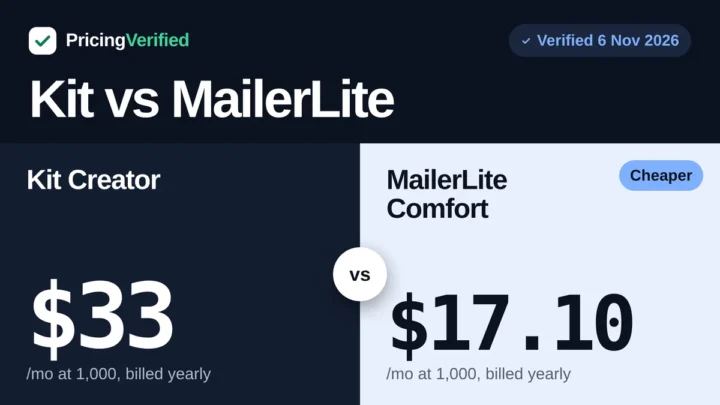
- MailerLite at $17.10 a month for 1,000 subscribers, if you need automations on a budget. See MailerLite pricing.
Which one should you pick?
| Your situation | Pick | Why |
|---|---|---|
| Free newsletter, no plans to charge | Either | Both start at $0 |
| Paid newsletter under $490 a month | Substack | 10% is less than beehiiv Lite |
| Paid newsletter above $490 a month | beehiiv Lite | 0% cut; check the price at your list size |
| Sponsor-funded newsletter | beehiiv Lite | Ad network included |
| Want discovery from a reader network | Substack | Its app and recommendations |
Switching from Substack to beehiiv
Moving a paid newsletter takes care. Export your subscriber list and paid subscriber data, import it, and check how paid subscriptions carry over before you switch on payments. Tell your readers a week ahead. Keep the Substack publication live during the move so archive links keep working. If you are close to the $490 line, wait until you are clearly above it; a move takes time you could spend writing.
Questions to ask before you choose
- What do I earn from paid subscriptions today? Compare 10% of it with beehiiv’s price at your list size.
- How big is my total list? beehiiv prices by all subscribers, not only paying ones.
- Do I want sponsors? beehiiv’s ad network starts on Lite.
- How do I get new readers? If Substack’s network brings many, that has value.
- Will I pay yearly? beehiiv Lite is $49 yearly and $59 monthly, which moves the break-even point.
The cost over three years
At a steady $1,000 a month in paid subscriptions:
| 3 years | |
|---|---|
| Substack (10%) | $3,600 |
| beehiiv Lite at the 1,000-subscriber price | $1,764 |
Our arithmetic. Your beehiiv price depends on your total list size, and Stripe fees apply on both.
That is about $1,800 over three years at the price we verified, and the gap grows with your revenue. On Substack, earning more always means paying more. On beehiiv, the price follows list size, not revenue.
Who should use neither
- Businesses that sell courses or coaching through email usually get more from Kit or MailerLite, which are built around funnels and automations.
- Writers who want a website, store and email together may prefer an all-in-one tool like Systeme.io.
How we compared
We checked beehiiv.com/pricing on 3 November and again on 6 November 2026, at 1,000 subscribers on yearly and monthly billing. Substack’s 10% fee comes from its help center, updated 29 September 2026. Every total on this page is our own arithmetic. Stripe’s card fees apply on both platforms, so we left them out.
Our verdict
For a paid newsletter that earns more than about $490 a month, beehiiv is the cheaper platform. It takes 0% of your subscriptions, so every extra reader adds to your income instead of Substack’s. At $1,000 a month in paid subscriptions, the saving against Substack is about $600 a year at the 1,000-subscriber price, and it grows from there.
Substack is the better deal while your paid revenue is small, because it costs nothing until you earn. Its reader network can also bring subscribers you would not find alone. For a writer just starting to charge, those are real advantages.
So here is my rule. Start wherever you like writing. Once your paid revenue passes $490 a month, open beehiiv’s slider, enter your real list size, and compare the price with 10% of your revenue. If beehiiv is clearly cheaper, plan the move.
beehiiv vs Substack FAQs
Is beehiiv cheaper than Substack?
If you earn more than about $490 a month from paid subscriptions, yes. beehiiv Lite is $49 a month billed yearly at 1,000 subscribers and takes 0%. Substack takes 10%.
How much does Substack take?
10% of paid subscription revenue, plus Stripe’s card fees, according to Substack’s help center.
Does beehiiv take a cut of paid subscriptions?
No. beehiiv takes 0% on Lite and Pro. Stripe’s card fees still apply.
Can I charge for a newsletter on beehiiv’s free plan?
No. Paid subscriptions and the ad network need Lite or higher.
How much is beehiiv billed monthly?
At 1,000 subscribers, Lite is $59 and Pro $109 on monthly billing, against $49 and $95 billed yearly.
Should I move from Substack to beehiiv?
Consider it once your paid revenue is clearly above $490 a month and beehiiv’s price at your real list size is lower than 10% of your revenue.
Does beehiiv have a free plan?
Yes, for up to 2,500 subscribers. It does not include paid subscriptions or the ad network.
How much does Substack cost per year?
Nothing to use. It keeps 10% of paid subscriptions, so at $1,000 a month in paid subs it costs $1,200 a year, plus Stripe fees.

Amanat Mossalli Taju
Amanat has spent 6+ years on the strategy side of digital businesses, working with 175+ brands including SaaS companies like Tactiq, Restoke.ai and WeMoney on pricing and growth. He checks every number on PricingVerified against the vendor's own pricing page.